B2B companies are often built on genuine expertise, long-standing client relationships, and consistent delivery.
But that track record is rarely visible to new buyers. Most B2B purchasing decisions are now shaped by what a buyer can find, compare, and verify online before they ever make contact.
And in B2B, the gap between what a company actually delivers and what a buyer can see is wider than in any other category.
TrustPoint gives B2B companies independently verified proof of real client outcomes. It turns years of delivery into structured, verifiable evidence that buyers and AI systems can find, evaluate, and trust. It is not a testimonial. It is not a case study written by your marketing team. It is an independently verified performance signal.
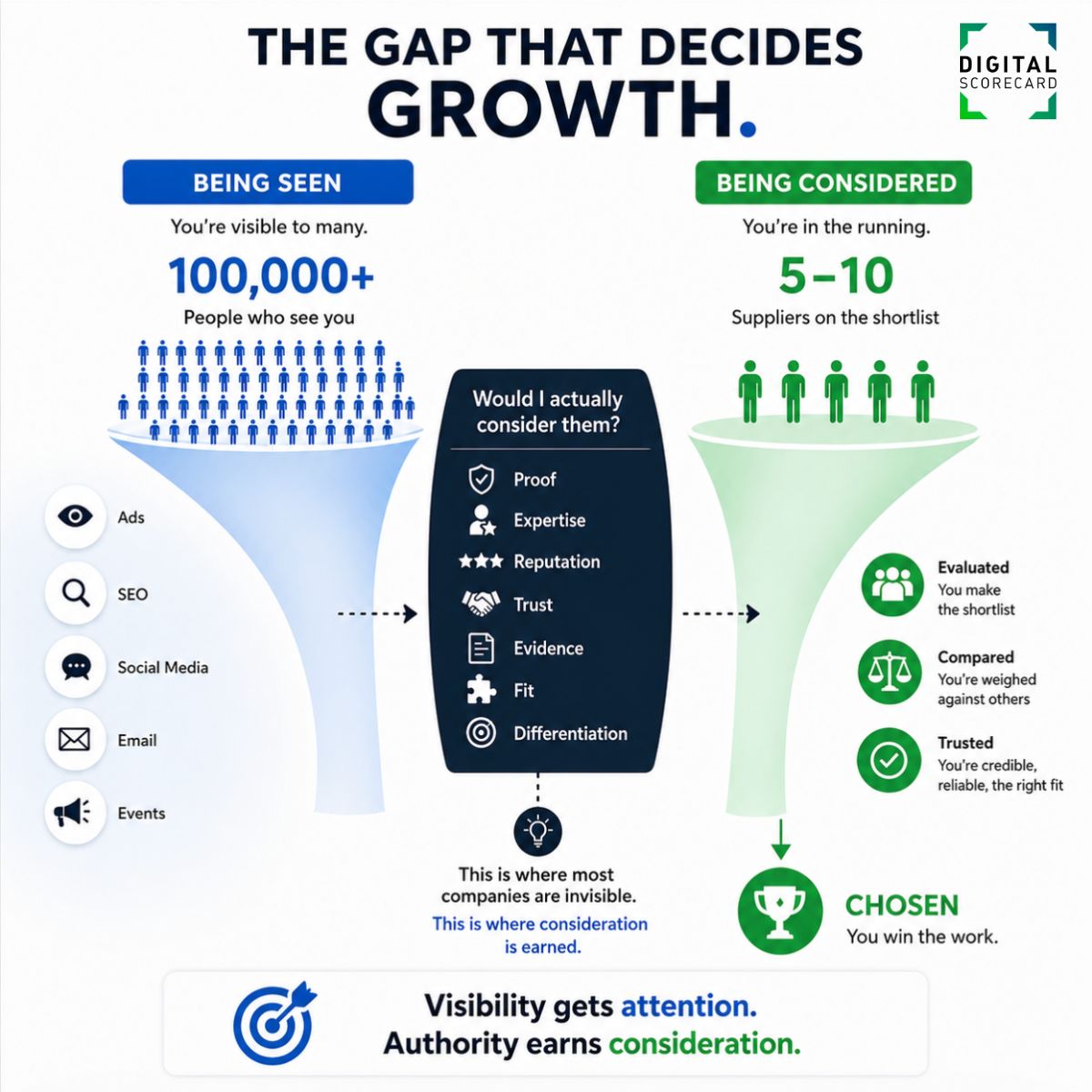
Digital Scorecard has assessed hundreds of businesses using the Market Authority Index. One finding stands out above all others: B2B companies consistently underperform on Proof and Validation.
Of the four pillars that make up Human Authority, Proof and Validation scores the lowest average (11.8 out of 25) and has the highest variation. That means most B2B companies are weak on proof, and the gap between those that have it and those that do not is enormous.
The pattern is clear. B2B companies invest in what they deliver but underinvest in making that delivery visible and verifiable. They rely on reputation, referrals, and relationships. But buyers increasingly make shortlists before they make calls. If your proof is not structured, independent, and findable, you may not make the list.
Some of the strongest businesses we have assessed, including sector-founding companies, are being overtaken in Market Authority by newer entrants who simply communicate their value better. The product has not changed. The proof has.
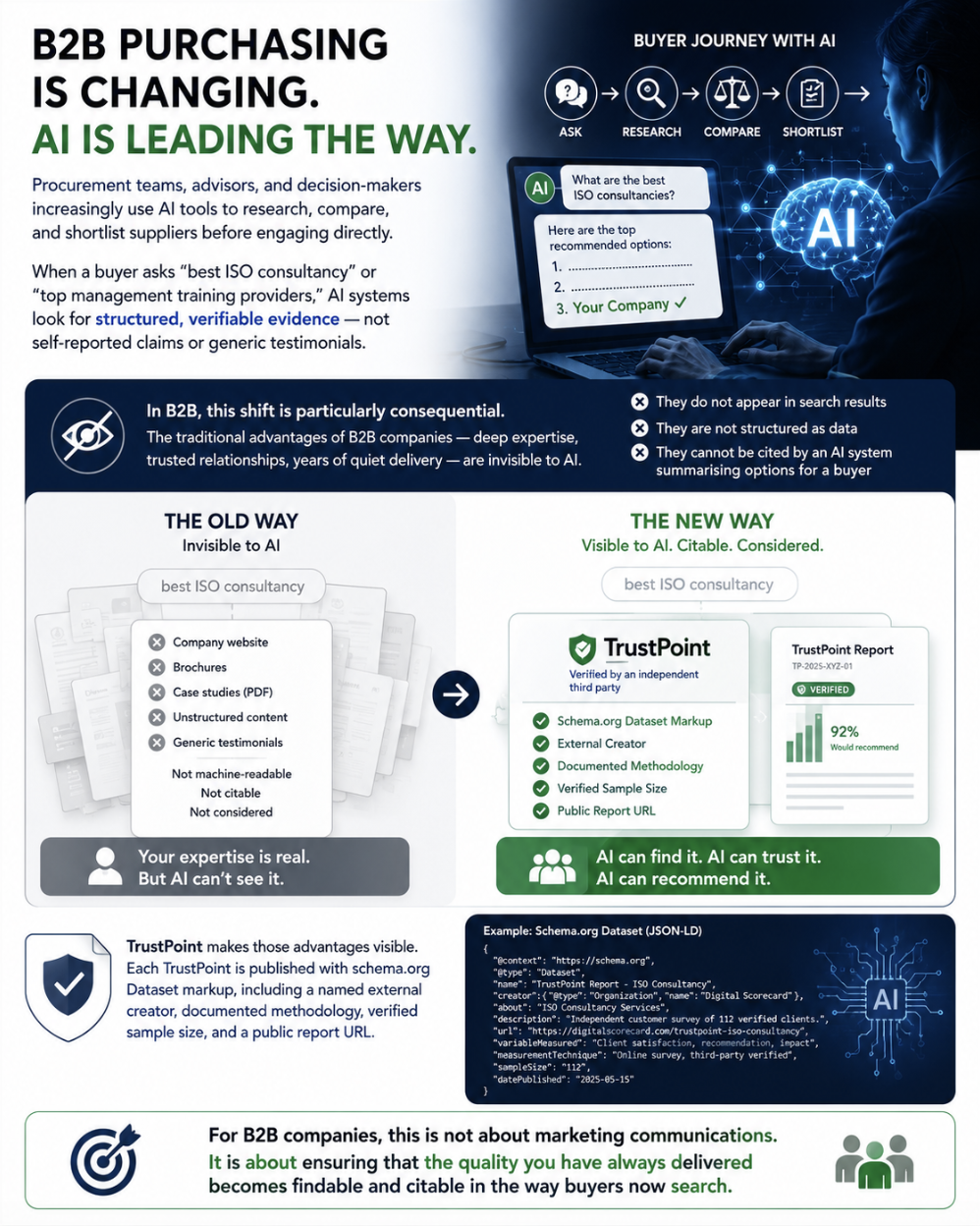
B2B purchasing is changing. Procurement teams, advisors, and decision-makers increasingly use AI tools to research, compare, and shortlist suppliers before engaging directly. When a buyer asks "best ISO consultancy" or "top management training providers," AI systems look for structured, verifiable evidence -- not self-reported claims or generic testimonials.
In B2B, this shift is particularly consequential. The traditional advantages of B2B companies including deep expertise, trusted relationships, years of quiet delivery are invisible to AI. They do not appear in search results, they are not structured as data, and they cannot be cited by an AI system summarising options for a buyer.
TrustPoint makes those advantages visible. Each TrustPoint is published with schema.org Dataset markup, including a named external creator, documented methodology, verified sample size, and a public report URL. This gives AI systems exactly the kind of machine-readable verification signal they prioritise when generating recommendations.
For B2B companies, this is not about marketing communications. It is about ensuring that the quality you have always delivered becomes findable and citable in the way buyers now search.
B2B buyers struggle to compare suppliers on anything other than price, scope, and promises. Every company claims expertise. Every proposal says "proven track record." But there is rarely an independent, structured way to verify those claims side by side.
TrustPoint creates that comparison layer. By independently verifying what clients actually experience such as business impact, service quality, outcomes relative to alternatives, it produces a structured, comparable result. The comparison is grounded in what your clients report, not what your sales team presents.
For B2B companies that genuinely outperform, this is an advantage. For the first time, the quality of your delivery becomes as visible as the quality of your competitors' marketing.
Buyers see verified outcomes they can trust. Not a testimonial on your website, not a case study your team wrote, but an independently verified result: "98.35% of participants confirm participation will help their business increase sales" or "81.2% say certification improved their business standing." Those findings carry weight because they were not produced by the company. They were verified by an independent third party using a documented, repeatable methodology.
In proposals, on your website, in tender responses, and inside AI-generated supplier comparisons, these verified outcomes become the most credible element a buyer encounters. They answer the question every B2B buyer is silently asking: can this company actually deliver what it claims?
B2B has always relied on trust. But trust built through personal relationships does not scale, and it does not transfer to new buyers researching your company for the first time. TrustPoint makes trust visible by grounding it in independently verified evidence rather than claims.
Not reward based. TrustPoint results cannot be purchased or influenced. The outcome reflects what your clients actually report.
Verified using data. Every TrustPoint is based on independently administered research with a documented methodology and verified sample. In B2B, where the buyer’s decision often carries significant organisational risk, independently verified evidence reduces that risk in a way that self-reported proof cannot.
Independent. Digital Scorecard administers the research, analyses the data, and publishes the result. The company cannot edit, filter, or suppress findings.

Scandbed supplies quality bedding to hotels across Sweden. Their TrustPoint, based on 112 verified responses, revealed a critical insight: 91.2% of customers bought direct for their own home after they slept in a hotel with their bedding, because of improved sleep. With a DCI of 89.15 (above 60 is good) and a 100% recommendation rate, the TrustPoint data did not just verify performance, it uncovered the real benefit driver that the business had not seen from the inside. View the Scandbed (Bed of Scandinvia) TrustPoint here.
Statius, a B2B ISO management and certification consultancy, verified through 64 client responses that 81.2% say ISO certification improved their business standing. 56.1% report that registration helped them secure more sales, and 30.4% say it allowed them to bid for larger contracts. In a professional services category where every provider claims expertise, Statius can now point to independently verified client outcomes as proof. View the TrustPoint here.


Digital Scorecard’s workshop programme with ALMI for small and medium-sized businesses has been independently verified through 303 participant responses collected over five years. 98.35% of participants confirm the programme will help their business increase sales, and 99.1% would recommend it to others. Delivered in partnership with ALMI, the programme’s TrustPoint demonstrates sustained, verified impact over time, not a single snapshot, but a longitudinal track record of consistent delivery. You can see the TrustPoint here.
See more details from 3 businesses and how TrustPoint can be used.
These principles are enforced through issuance criteria. If they are not met, no TrustPoint is issued. Methodology alone does not qualify an insight as a TrustPoint. Issuance depends on observed, repeatable customer patterns.
Only real, verified customers are included. No exceptions.
We do not rely on simple ratings. We use a structured, in-depth questioning framework.
Each TrustPoint is adapted to suit your business, industry and objectives.
Results cannot be bought, influenced, or edited. Each client can decide to publish their results or not.
TrustPoint was refined over years of real-world application before launch.
A structured methodology that ensures statistically robust results and full credibility.
You receive a full report with highlights you can immediately use in sales, marketing, and positioning. You decide what to make public and are always in control of how to use the results.
You will be able to use the TrustPoint badge as a confirmation of your results.
While you cannot influence the results, you can decide on what aspect to illustrate. We will not show you in a bad light and will only show what you want.
The primary reason for doing a TrustPoint is to illustrate how customers benefit from your products or services.
A TrustPoint helps your AI listing and strengthens your position by
All TrustPoint work is based on a robust methodology and all results are statistically sound. This is essential for the TrustPoint badge to have real value.
In some sectors, our findings have closely mirrored clinical trial outcomes. While TrustPoint is not a clinical trial, we apply rigorous standards to ensure accuracy, reliability, and trust.
The Differential Comparison Index (DCI) is a benchmark used to measure how well a product performs compared to other alternatives customers have tried. It is calculated from verified customer responses that compare their experience with the product to similar products on the market.
DCI is scored on a scale of 0 to 100:
A high DCI score indicates that the product not only satisfies customers but outperforms other options they have used. This provides an independent competitiveness measure beyond standard satisfaction ratings.
There are three TrustPoint levels, based on your business needs. All include a verified TrustPoint and the difference is depth and detail.
When you purchase a package we always discuss the options with you before we start so you are not locked into one package.
We offer a clear money-back guarantee.
If you’re not satisfied with your TrustPoint, you can request a refund.
As we have done this for a while we have seen that clients see the value and even sales during the process itself. That confidence allows us to remove the risk for you by offering a simple money back guarantee.